Who Was One of the Foremost Patrons of Art During the Renaissance
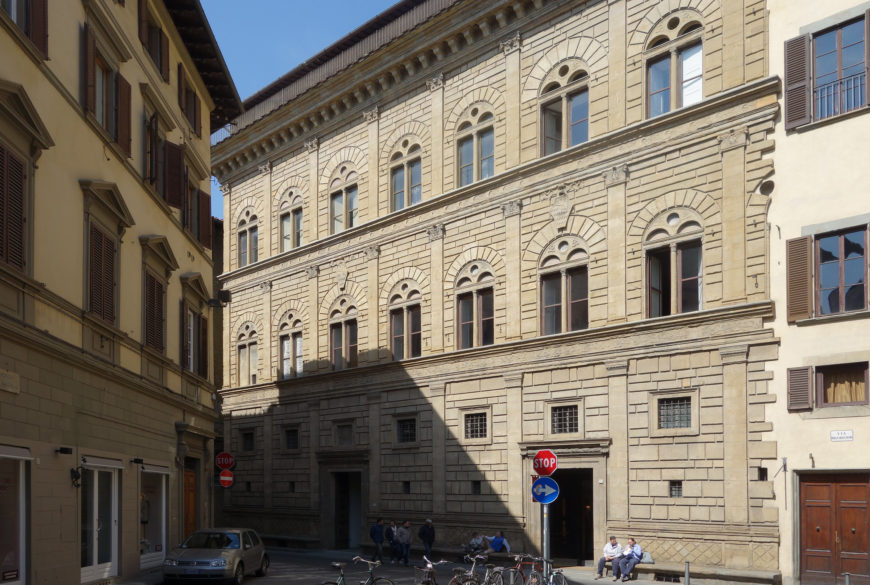
Leon Battista Alberti, Palazzo Rucellai, c. 1446–51, Florence, Italy (photograph: Steven Zucker, CC BY-NC-SA 2.0)
What's in information technology for me?
Why would someone patronize fine art in the renaissance? Giovanni Rucellai, a major patron of art and architecture in fifteenth-century Florence, paid Leon Battista Alberti to construct the Palazzo Rucellai and the façade of Santa Maria Novella , both high – profile and extremely costly undertakings. In his personal memoir, he talks most his motivations for these and other commissions, noting that "All the in a higher place-mentioned things have given and give me the greatest satisfaction and pleasance, because in part they serve the accolade of God every bit well every bit the honour of the urban center and the commemoration of myself." [1]
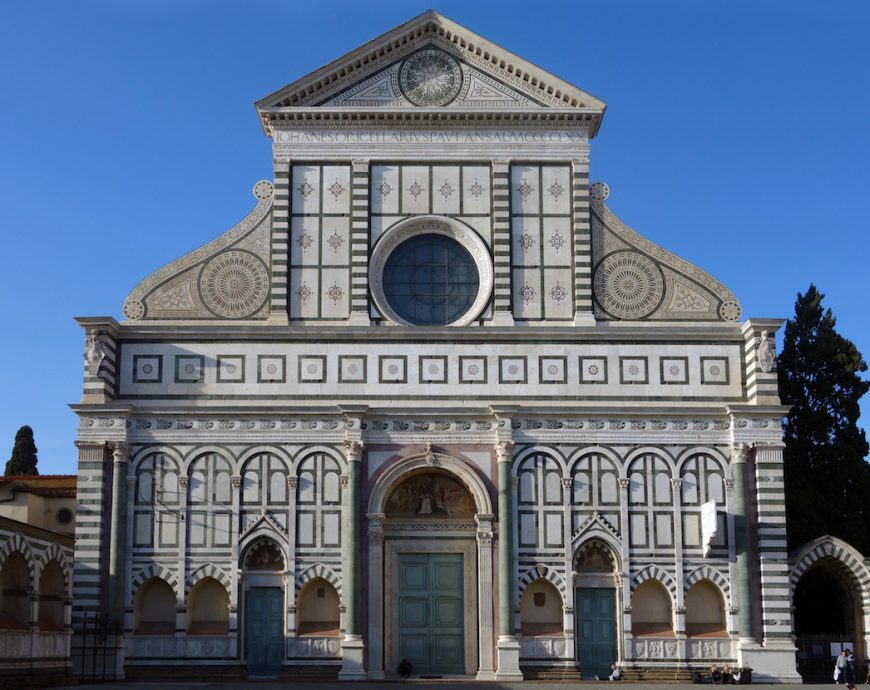
Leon Battista Alberti, Façade of Santa Maria Novella, Florence, 1470 (photograph: Steven Zucker, CC BY-NC-SA 2.0)
Aside from bringing accolade to one'due south organized religion, city, and cocky, patronizing art was likewise fun. Earning and spending money felt adept, especially the spending role. Equally Rucellai goes on, "I actually think that it is even more pleasurable to spend than to earn…." [2]
The aboriginal Roman earth (with which much of renaissance Europe was incessantly fascinated) also provided motivation for patronage. The liberal expenditure on art and architecture by ancient Roman patricians was celebrated in the literature of antiquity and survived—even if in fragmentary course—to dazzle the optics of renaissance viewers. The Roman Emperor Augustus, who so famously said that he establish Rome a city of brick and transformed information technology into a urban center of marble, provided the ultimate noble model of patronage.
Cocky-fashioning
Commissioning an artwork oft meant giving detailed directions to the creative person, even what to include in the piece of work, and this helped patrons fashion their identities. While the identity of Bronzino's Florentine sitter in a Portrait of a Young man is unknown, the artist shows him standing confidently in the limerick'southward center, looking out at us while dressed in expensive blackness satin, slashed sleeves, and a codpiece complete with gold aglets. He holds his fingers between the pages of a poetry volume, which rests atop a table carved with grotesque faces. The volume and the table were undoubtedly intended to convey the homo'due south sophistication and learning while his wear and upright posture showed his wealth and nobility.
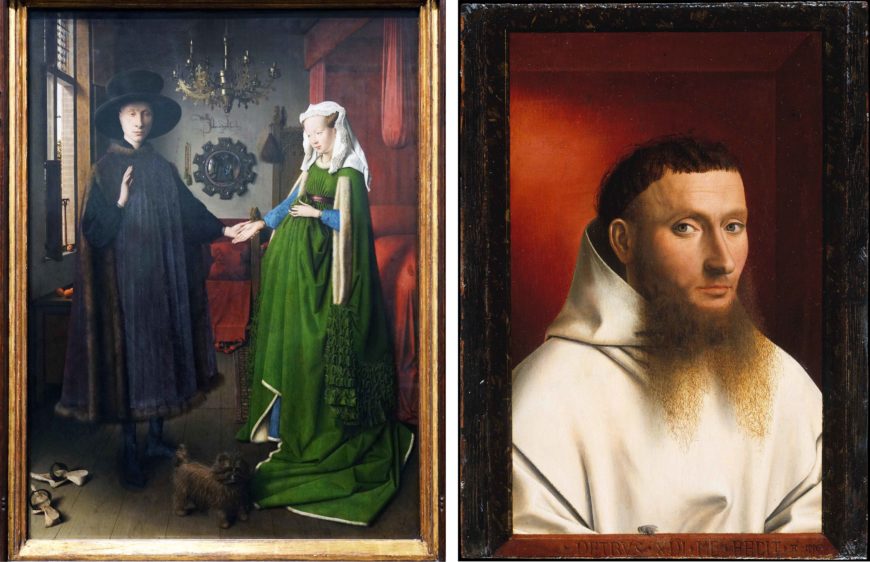
Left: Jan Van Eyck, The Arnolfini Portrait, 1434, tempera and oil on oak console, 82.2 x lx cm (National Gallery, London; photograph: Steven Zucker, CC BY-NC-SA ii.0); right: Petrus Christus, Portrait of a Carthusian, 1446 (The Metropolitan Museum of Art)
The renaissance was also a time when increasingly wealthy heart-class merchants and others aspired to increase their social recognition and began to committee portraits, as we see in double portraits like Jan van Eyck's The Arnolfini Portrait showing the Italian merchant Giovanni de Nicolao di Arnolfini with his married woman in Bruges (in nowadays-day Belgium). Petrus Christus's Portrait of a Carthusian reveals the increasing prominence of religious figures, with clergy, monks, and nuns sitting for portraits, many of which were likely made to celebrate the entry of wealthy individuals into religious orders.
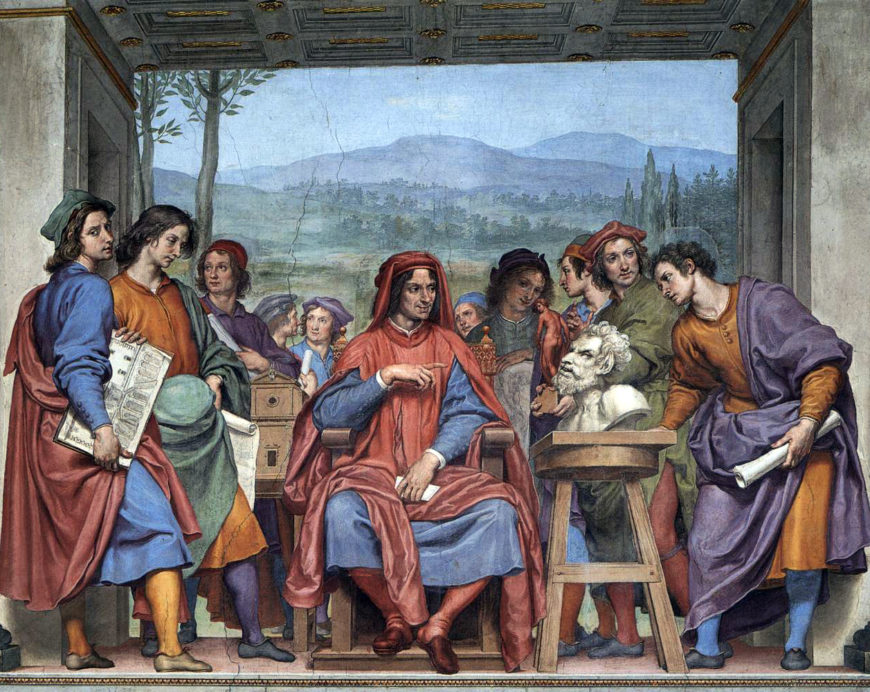
Ottavio Vannini, Michelangelo Presenting Lorenzo the Magnificent de' Medici with his Sculpture of a Faun, 17th century, fresco, Palazzo Pitti, Florence
Wealth, ability, and status
In a seventeenth-century fresco by the artist Ottavio Vannini, Michelangelo, the creative person, is shown presenting the powerful Florentine, Lorenzo the Magnificent de' Medici, with a sculpture of a faun. Lorenzo sits at the center of the image, facing frontally similar a ruler, while Michelangelo stands off to the side, bowing respectfully towards him. While today the proper name Michelangelo is better known, in the fresco the Medici patron is shown as more important than the artist.
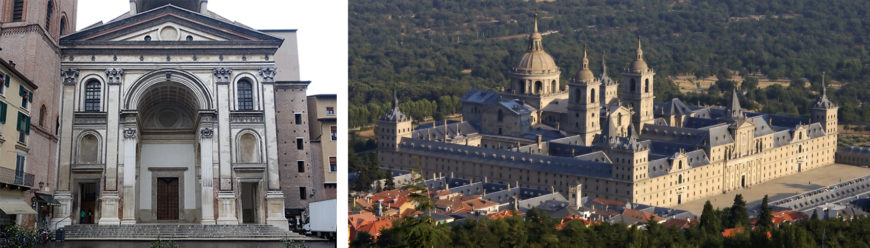
Left: Leon Battista Alberti, Basilica of Sant'Andrea, 1472–ninety, Mantua (Italy) (photo: Steven Zucker, CC: BY-NC-SA three.0); right: El Escorial, begun 1563, near Madrid, Spain (photo: Turismo Madrid Consorcio Turístico, CC Past 2.0)
Paying for something lavish and awe-inspiring, such as Sant'Andrea in Mantua (commissioned by Ludovico Gonzaga, ruler of the Italian city-state of Mantua and built by Alberti) or El Escorial (commissioned by Philip II, Male monarch of Spain, outside of Madrid), was a powerful statement nigh a patron'due south wealth and status. Philip II was deeply involved in the planning of the massive complex that became El Escorial (a monastery, palace, and church building). The complex was congenital in an ascetic, classicizing style that was intended to showcase Philip'due south imperial power by looking to ancient Roman architectural forms.
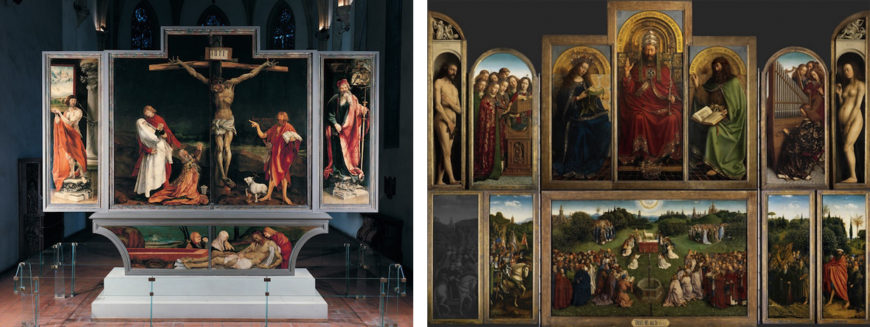
Left: Matthias Grünewald, Isenheim Altarpiece, view in the chapel of the Hospital of Saint Anthony, Isenheim, c. 1510-15, oil on wood, 9′ 9 1/2″ x 10′ 9″ (closed) (Unterlinden Museum, Colmar, France); right: Jan van Eyck, Ghent Altarpiece (open), completed 1432, oil on woods, xi feet 5 inches x 15 feet 1 inch (open), Saint Bavo Cathedral, Ghent, Belgium. Note: Just Judges panel on the lower left is a modern copy (photograph: Closer to Van Eyck)
Spiritual comfort and salvation
Some patrons paid for art to serve a larger purpose, perhaps to fulfill a devotional or religious need, as the Isenheim Altarpiece did for people suffering from the painful illness of ergotism. Others deputed fine art to expiate the patron's sins for such things every bit usury, as Jodocus Vijd desired when he paid a large sum of money for the Ghent Altarpiece .
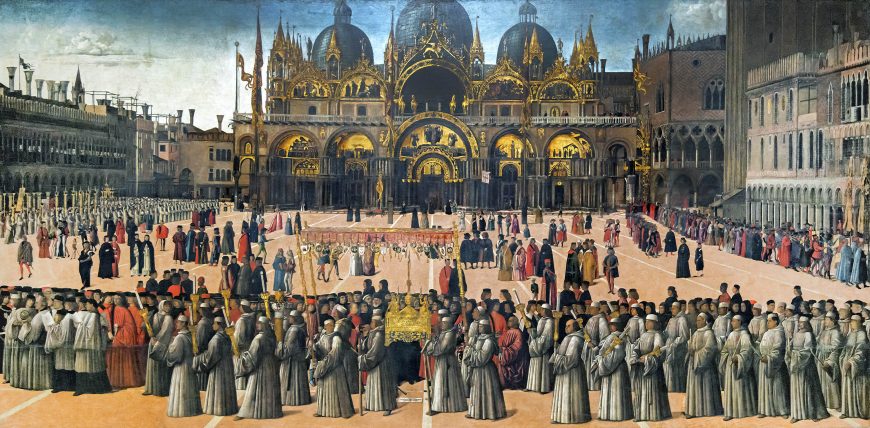
Gentile Bellini, Procession in St Mark'due south Square, 1496, tempera on sheet, 347 ten 770 cm (photograph: Steven Zucker, CC: BY-NC-SA iii.0; Gallerie dell'Accademia, Venice)
Inspiring civic duty and responsibleness
Commissioning artworks likewise helped to inspire civic responsibility or to demonstrate that members of a particular customs performed their duties properly. The Scuola Grande di San Giovanni Evangelista , one of many Venetian devotional confraternities, paid Gentile Bellini to depict the procession of the relic of the True Cross through St. Mark's square. This commission highlights the importance of the miraculous object besides as the civic duty of the metropolis's citizens, who are shown in the painting's foreground, with the Scuola members carrying a canopy higher up the relic.
Patrons in art
Patrons often had themselves incorporated into paintings and sculptures to remind viewers of who had paid for the work of art as well every bit to evidence themselves participating in the narrative. We call these "donor portraits." Lluis Dalmau'due south Virgin of the Councillors , for example, shows the Virgin Mary enthroned, holding the infant Jesus and surrounded past saints in a luxurious Gothic interior. Kneeling before the saints, at the edge of the throne, are five men, all of whom were members of the Barcelona City Council (Casa de la Ciutat), who had paid Dalmau to create the painting to hang in the chapel at the council palace. The portrait collapses sacred and secular fourth dimension, placing the men as perpetually revering Mary and showcasing their piety to anyone observing the painting.
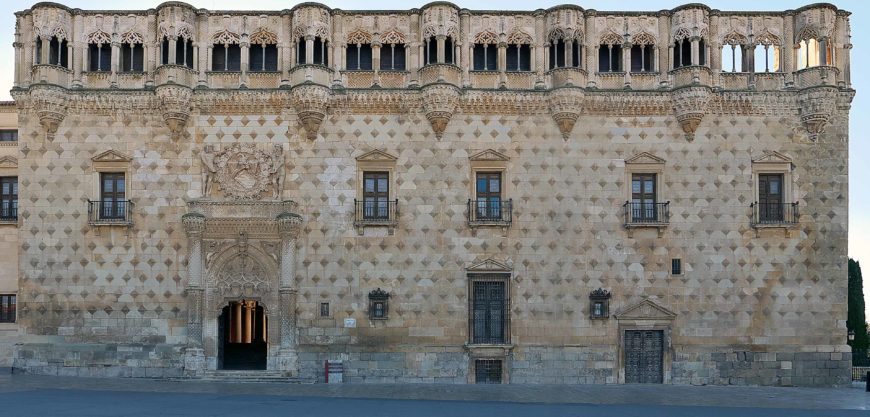
Juan Guas, Palacio del Infantado, 1480, Guadalajara, Kingdom of spain (photo: José Luis Filpo Cabana, CC Past 3.0). The patron was Íñigo López de Mendoza y Luna.
Fifty-fifty in instances where patrons were not overtly depicted in artworks, artists would sometimes be directed to include heraldic symbols, visual puns, or other motifs to allude to the patron. The coat of artillery of the wealthy Mendoza family rests in a higher place master entrance to the Palacio del Infantado (in Guadalajara, Spain) amidst the decorative plateresque elements, and advertisement to whatever passersby who had paid for and lived in the striking palace.
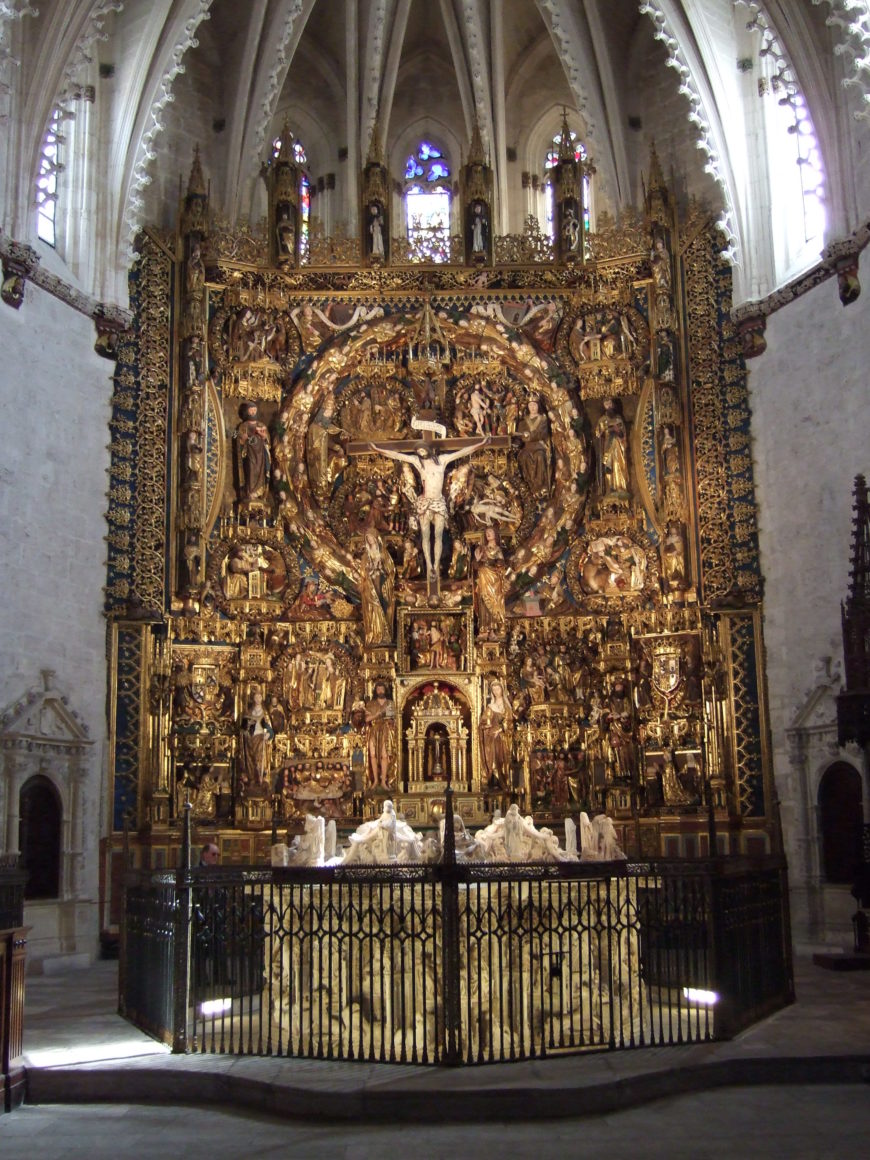
The Tomb of Juan II of Castile and Isabel of Portugal in front of the altar of the church of the Carthusian Monastery of Miraflores (photo: Ecelan, CC BY-SA iv.0)
Patrons every bit influencers
Patrons too fix fashions for style and subject field affair. Importing artists and artworks from distant lands could show off one'due south sophistication and introduce new styles, techniques, and subjects to local audiences. Artists and art traveled widely during this period, and exchanges across Europe and beyond were mutual. Considering of the wealth and glamour of northern European court civilization, it was fashionable for the wealthy elite of Italy and Spain to import both Netherlandish art and artists. Queen Isabel of Castile, whose begetter had favored Flemish painters such as Rogier van der Weyden, had a number of artists, including Juan de Flandes, Michel Sittow, and Gil de Siloe, at her courtroom to create lavish works that would speak to her power and magnificence.
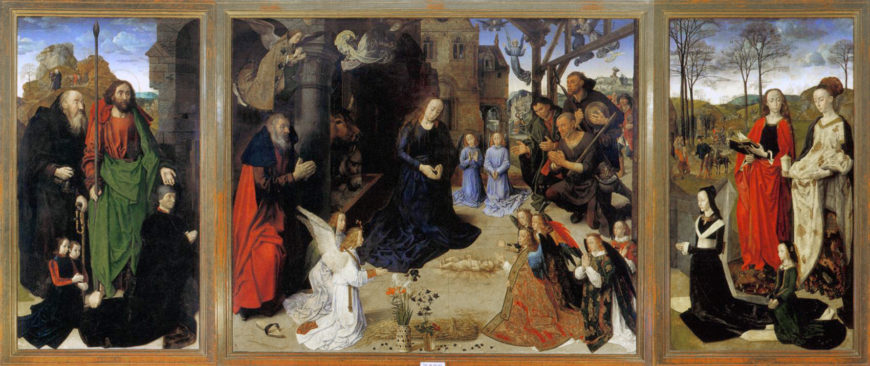
Hugo van der Goes, Portinari Altarpiece, 1476 and 1470, oil on console, 253 cm x 586 cm (Uffizi Gallery)
Besides, Tomasso Portinari, who worked for the Medici bank in Bruges, hired the northern artist Hugo van der Goes to paint a massive altarpiece of the Nativity for his home town of Florence, Italy. When put on display in the hospital church of Santa Maria Nuova in 1483, it created a sensation. Italian artists, in awe of the accomplishments of the northern master, quickly responded to what they saw. Portinari non merely showcased his own cosmopolitan composure, he also helped shape the management of Florentine fine art past introducing this spectacular prototype to local artists.
Why patrons affair
Art communicated ideas about patrons. Status, wealth, social, and religious identities all played out beyond paintings, prints, sculptures, and buildings. At the same time, the careers of artists were shaped with the aid of powerful patrons. Likewise, artistic styles emerged or adult as a outcome of patrons hiring artists or buying artworks and past transporting them to new locations. The history of art has been shaped non only by artists, but likewise by the patrons whose choices in sponsorship determined what art was created, who created information technology, who saw it, and what fine art was made of. Until the modernistic era, the stories that have been told in art are the stories that reverberate the interests of the rich and powerful, the privileged few—more often than not men—who were in positions to patronize art. In a nutshell, patronage mattered.
Notes:
[one] Giovanni Rucellai, Giovanni Rucellai ed il suo Zibaldone , ed. Alessandro Perosa. 2 vols. (London: The Warburg Institute, University of London, 1960), 1:121
[two] Rucellai, Zibaldone , 1:121
Boosted resources
Read more about Isabella d'Este and her patronage
Learn more about patronage in fifteenth-century Burgundy
Explore renaissance Spain further, and larn more than about the patronage of Queen Isabel of Castile
Larn more about Patrons and Artists in Late 15th-Century Florence from the National Gallery of Art
Read about patronage at the afterward Valois court on the Heilbrunn Timeline
Fine art from the Court of Burgundy: The Patronage of Philip the Bold and John the Fearless 1364–1419 ( Dijon, 2004)
Michael Baxandall, Painting and Experience in Fifteenth-Century Italia: A Primer in the Social History of Pictorial Manner , 2d ed. (Oxford: Oxford University Press, 1988)
Rafael Domínguez Casas, "The Artistic Patronage of Isabel the Catholic: Medieval or Modern?," in Queen Isabel I of Castile: Power, Patronage, Persona , edited by Barbara F. Weissberger (Boydell & Brewer, 2008), pp. 123–48
Alison Cole, Virtue and Magnificence: Art of the Italian Renaissance Courts (New York: H. Due north. Abrams, 1995)
Tracy E. Cooper, " Mecenatismo or Clientelismo ? The Character of Renaissance Patronage," in The Search for a Patron in the Middle Ages and the Renaissance , edited past David Grand. Wilkins and Rebecca L. Wilkins (Medieval and Renaissance Studies 12. Lewiston, NY: Edwin Mellen, 1996), pp. xix–32
Mary Hollingsworth, Patronage in Renaissance Italy: From 1400 to the Early Sixteenth Century (London: Thistle, 2014)
Robrecht Janssen, January van der Stock, and Daan van Heesch, Netherlandish Art and Luxury Goods in Renaissance Spain: Studies in Honor of Professor Jan Karel Steppe (1918–2009) (Belgium: Harvey Miller Publishers, 2018)
Dale Kent , Cosimo De' Medici and the Florentine Renaissance: The Patron's Oeuvre (New Haven: Yale Upwards, 2000)
Catherine E. King and Margaret L King, Renaissance Women Patrons: Wives and Widows in Italia, C. 1300–1550 (Manchester: Manchester Upwards, 1998)
Sherry C. M. Lindquist, Agency, Visuality and Society and the Charterhouse of Champmol (Aldershot and Burlington, 2008)
Michelle O'Malley, The Business of Art: Contracts and the Commissioning Process in Renaissance Italy (New Haven: Yale Upwardly, 2005)
Sheryl Reiss, "A Taxonomy of Fine art Patronage in Renaissance Italian republic," in A Companion to Renaissance and Baroque Art , ed. Babette Bohn and James M. Saslow (Chichester, Westward Sussex United kingdom of great britain and northern ireland: John Wiley & Sons, 2013), pp. 23–43
Hugo Van der Velden, The Donor'southward Prototype: Gerard Loyet and the votive portraits of Charles the Bold (Turnhout, 2000)
Jessica Weiss, "Juan de Flandes and His Financial Success in Castile," Journal of Historians of Netherlandish Fine art 11:1 (Winter 2019) DOI: 10.5092/jhna.2019.11.1.2
Cite this page equally: Dr. Lauren Kilroy-Ewbank and Dr. Heather Graham, "Why committee artwork during the renaissance?," in Smarthistory, April 24, 2020, accessed April 26, 2022, https://smarthistory.org/renaissance-patrons/.
Source: https://smarthistory.org/renaissance-patrons/
0 Response to "Who Was One of the Foremost Patrons of Art During the Renaissance"
Postar um comentário