God Set Me Free From a Bad Business Deal With Family Member
Executive Summary
In the picture show The Godfather, Michael Corleone, the youngest of three sons, is chosen as successor of the New York mafia family throne, subsequently his eldest brother is slain and over his older brother Fredo. While tradition generally designates the eldest kid as successor in well-nigh family unit businesses, Fredo Corleone, less intelligent and weaker in character than his younger brother Michael, is superseded past Michael. The incendiary family dynamics that ensue, sparked by Fredo'southward acrimony and resentment toward his own family unit, cease with betrayal and in the tragic demise of Fredo himself.
In real-life family businesses, similar dynamics (though typically not every bit grave) tin arise in which children may get overlooked for leadership positions or roles of successorship because of their lack of experience or skill. And yet, business-possessor parents often feel obligated to 'take care of' their children, and sometimes end up giving them inconsequential roles in the business concern because they want them to at least notwithstanding be involved (which can sometimes also include a disparately high level of compensation because they want to provide what they tin for their child). Alternatively, children can at other times exist given roles that they are outright ill-equipped to handle (i.e., nepotism), which tin result in bad decisions that crusade harm to the visitor itself.
Thus, while these business-owner parents may only have the best intentions for their children, the behaviors and family dynamics that result can be counterproductive, arising in circumstances that can ultimately hurt the family business. This state of affairs is called the "Fredo Effect", and refers to the damage that results from the dysfunctional interactions between parents and children in the context of a family unit business concern.
The master cause of the Fredo Effect oftentimes boils down to "role ambivalence", in which parents accept difficulty separating their role as business possessor from that of parent. The kid, too, can accept part ambivalence challenges, as they frequently take unclear guidance about their role in the business, complicated by (often unfair) overcompensation they might receive, and may thus struggle to sympathise what specifically is expected of them.
Not only are parents and children affected past the Fredo Effect, but other employees and family unit members involved in the business concern are also impacted. Seeing a kid-employee get compensated and otherwise rewarded for a task-not-well-done can be demoralizing to workers who are diligent and dedicated to their jobs, but who get none of the recognition or benefits that "Fredo" gets. Over time and left uncorrected, the situation tin lead to astringent erosion of employee morale and working conditions.
The most effective way to mitigate (and potentially forestall altogether) the Fredo Outcome is to ensure that formal, well-written job descriptions are in identify, which conspicuously ascertain the standards and expectations for each role in the company. Establishing a "family quango" can as well provide a forum to facilitate open communication between family unit members, which tin can aid them piece of work through part ambiguity challenges by identifying (and delineating between) personal and concern concerns, and talking them through with family members.
Financial advisors tin can help their clients past offering services to assistance them implement these solutions. For example, an counselor can aid their family-business-owner clients in reviewing job descriptions to ensure that they conspicuously ascertain the role, requirements, and expectations for each chore; that a sensible reporting structure is in identify; and that growth and development opportunities exist for all current employees. Advisors tin can also participate every bit an objective expert in family council meetings (and also facilitate the participation of other subject-matter experts every bit needed). And finally, advisors can help family-business organisation-owner clients constitute their own back up arrangement with each other, past analogous introductions and hosting instructional events around issues relating to the Fredo Effect.
Ultimately, the central betoken is that many family-business organization owners struggle with part ambivalence issues when it comes to their children. The children, too, face up role ambivalence challenges that tin lead to dysfunctional behaviors, which can be potentially harmful for the concern itself. Financial advisors with family unit-business-possessor clients are in a unique position to serve as an objective 3rd-party expert to help the family unit mitigate the furnishings of Fredo, and ideally prevent them from arising at all in the first identify.

The Fredo Result: A Family Businesses' Poorest Performer (Or Worse)
If you lot're thinking Lord of the Rings right at present, this is not quite right. That is Frodo. And if y'all're now thinking, "Well and then, who is Fredo?", and then think of another super-famous multi-function film. Fredo was the middle son in The Godfather saga, based on the novel by Mario Puzo. Frederico "Fredo" Corleone was the older blood brother of Michael Corleone (played by the very young Al Pacino).
Fredo is infamous because, even though older than Michael, he was overlooked as the successor to the Corleone's crime syndicate subsequently patriarch Don Vito (played by Marlon Brando, Academy Honor winner for All-time Actor) stepped down and Santino "Sonny" Corleone, the eldest of the 3 brothers, had been brutally gunned down and killed. Fredo was non chosen for the position because he was, putting it nicely, a poor performer (and was thus sent to Nevada to learn the casino business organisation, becoming an alcoholic, womanizer, and known for his poor business organisation deals). Ultimately, Fredo betrays the family, sabotaging Michael's piece of work out of jealousy and anger, and tragically earns the "buss of death" – the indicate leading to his bloody demise – from his own brother.
Accordingly, the "Fredo Effect" is a term coined by researchers Roland Kidwell, Franz Kellermanns, and Kimberly Eddleston in 2012, who surveyed 147 family members of family-run businesses to examine how human relationship dynamics potentially bring rise to disharmonize manifesting in "dissentious unethical behaviors." The term is used to refer to the person in the family business who can be seen as a 'problem child' or obstacle to progress. Fredo would be the person that could be or is often described equally less skilled or less proficient – this is not the person you trust to get the job done or to come up up with adept ideas. Looking from the outside in, Fredo would probable exist the person 1 would depict as only having a job because their parents gave them one.
All the same, this is more than just another proper noun for nepotism. The Fredo Effect is actually more about the fallout from trying to disengage 'bad' nepotism gone wrong (as nepotism or more than generally hiring family members into the business concern tin become right, besides, and is oft what makes a family business so swell), which, according to research, is common. Still, though, of the firms that the researchers interviewed, one-third of the firms admitted to having a "Fredo".
Notably, a fundamental betoken of the Fredo Issue is that while Fredo generally gets their job because of nepotism, they aren't ordinarily placed in leadership roles (or given high-level responsibilities) considering of their lack of experience and/or competency, which helps to protect the business concern at least to some extent. However the fact that experience and competence ofttimes trump nepotism (specially in well-run businesses) can turn out to be the trigger that causes the person benefitting from the nepotism (i.e., Fredo) to backlash against the family firm. Which, in plow, can cause the family unit house to retaliate against Fredo.
As such, the Fredo Effect underscores that, while an impediment to the family businesses' progress tin be inconvenient, Fredo's beliefs (and the family's reaction to Fredo) can quickly escalate into something much more confusing. Kidwell et al. state that the "Fredo Effect undermines beneficial resources that are critical for the family unit firms, e.g., entrepreneurial capabilities, implicit knowledge, and social capital".
More than to the point on exactly how Fredo (and family) negatively impact pocket-sized businesses in particular (as once again non all nepotism is bad), is that succession is hard, and family relationships get in harder. For instance, research by Ibrahim, Soufani and Lam in 2001 found that less than a third of family firms successfully pass their concern on to the second generation, and but about half of that one-third brand information technology to a third generation, reinforcing the saying "shirtsleeves to shirtsleeves in iii generations".
Types Of Work Conflict That Spawn In Family Businesses
Why are the transition rates of family businesses from ane generation to the adjacent so low? The Routledge Companion to Family Business, edited by Franz W Kellermanns and Frank Hoy, compiles some general research on work conflict that identifies iii types of problematic conflicts:
- Chore conflict: Conflict over content and goals of the work
- Procedure conflict: Conflict over how work should be accomplished
- Relationship conflict: Conflict with interpersonal relationships
In family unit-run businesses, relationship conflict can be the toughest, as it is frequently magnified by what is called the "dual-office dynamic". This is when a person'due south work role and family office brainstorm to mix together. For example, while a business possessor tin fire Fredo, they will still have to socialize with Fredo at family events. And the claiming of successful transitions is due in big part to the relationship conflict that family unit businesses struggle with.
Basically, Fredo can potentially make both home and work environments very uncomfortable. And the discomfort is not experienced only by family members; information technology tin also exist uncomfortable for co-workers who do not share bloodlines. It is disheartening for any worker to watch another worker movement up, go a enhance, or bring together a project simply because they are a family member and despite the fact that anybody (family and non-family unit) knows the person just is non capable of cutting it. What is more than, keeping Fredo effectually can as well send the incorrect reinforcement messages. For example, others may perceive that Fredo receives praise/pay for acting out or for unethical or confusing behavior, and might assume that they too can be rewarded for like actions.
The two previous examples were internal (eastward.m., problems in family meetings and inside the firm), merely bug with Fredo can as well impact situations externally. For instance, if a fight between family unit members is public, it is non unheard of for the relationship conflict to impact actual market place value. One example is Marketplace Handbasket, a U.s.-based grocery, where the CEO, Arthur T. Demoulas, was forced out by a cousin over questionable business organization decisions. When the fight became public it impacted the workforce, resulting in a strike that ultimately cost the company $10M per solar day and probable impacting its customer base.
How Fredos Are Formed And How To Mitigate The Fredo Event
As one would judge, the process of stopping Fredo can be extremely dangerous for familial bonds, let solitary company relationships, and is complicated by the family dynamics involved. As previously discussed, the Fredo Result forms when family businesses blur the lines between work and family, which is (as it turns out) natural and normal to do – and hence probably why the Fredo Effect is and so commonly constitute.
For case, in a family setting we would expect that parents have care of their children and may give more than or less to a child based on that child's needs. When one child is ill, we stay habitation and care for the child, while the other children go to school. Unfortunately though, this same sort of natural, nurturing, and mutual parent-child behavior – to favor or take care of the weak child – can cause bug in the workplace.
When a child employee isn't performing well in the family unit business, the parents/business owners may give their kid a raise or a new title and hope that this 'bump' in recognition and/or responsibility volition spur them into activeness. This is generally non a expert strategy, though, as it frequently just serves to reward the prior bad behavior.
Moreover, what can make a slap-up parent is oft what makes a bad boss, because it is hard non to 'boss' in the same way that you parent when your employees are your kids or family members. In other words, the effect that breeds the Fredo Effect is office ambiguity at all levels of the family – not just for Fredo, whose roles equally kid and employee may non exist well-understood (by Fredo and everyone else), simply likewise for the business concern owners who may struggle with balancing their actions between running a successful concern as a business owner and nurturing/enabling unmotivated family members as a parent.
For instance, when it comes to discipline, parents may notice information technology hard to rebuke their children and instead choose to invoke permissive parenting styles in the workplace (eastward.m., instead of firing Fredo for a job poorly done, they actually give Fredo a enhance or promotion to encourage him to exercise better). The problem with this beliefs is that Fredo coming to expect (undeserved) generosity can foster a sense of unfounded entitlement, where children employees might believe they deserve the next raise too without doing anything to actually earn that raise either.
Children employees who lack the discipline to do their assigned jobs (yet who are nonetheless rewarded anyway) also weaken connections between the family and employees of the family unit firm. Again, the child's belief that they are entitled to sure ability, respect, and money (without actually having done annihilation to earn this power, respect, and money) can cause the kid to become increasingly dependent on their identify in the business firm, and the human relationship (between family members and house) to become increasingly unstable. For instance, even though the child may sense that their power, respect, coin, and human relationship is based on a pretentious pseudo-role in the business firm, they yet crave feelings of being respected, supported, and appreciated; appropriately, the kid's suspicion that their position may actually be unstable and unnecessary might lead them to need even more from their parents, or to human action out by exerting power on others equally a reflection of their own insecurities.
The senior generation may struggle as both parents and bosses with preferential treatment based on family ties instead of on merit. This can exist seen in situations where there is a belief that a certain kid might be at a disadvantage and 'needs' help more others. For instance, i child employee may need more because they have a baby (a grandchild), then they get a raise over another child employee (or a not-family employee) who might really take been doing all of the work. The senior generation wants to help as a parent, but in doing so brings near other issues such equally resentment and confusion about the company's work ethic.
Role ambiguity also exists for lower generation family members. For case, some children of the senior generation working in the house may be privy to private business data (e.g., finances), while others are deliberately kept out of the loop. This tin can make family gatherings uncomfortable. For example, if the company has had a rough couple of quarters and yet Fredo is spending their profit distributions lavishly (without even realizing the company may exist ailing) inside their personal lives, it may feel very awkward and may even create antagonism betwixt family members who may feel that Fredo (and the business firm management, who is rewarding Fredo to begin with) is behaving irresponsibly with respect to the business, while they are tightening their belts and fearing for their jobs.
Children may also be given jobs that they are just unprepared for. Perhaps this is because the senior generation wanted to kick-first a struggling lower generation family unit fellow member, or information technology may just have been the fashion the cards roughshod. Whatever the reason, though, beingness under-qualified for key roles could endanger the firm (e.g., perhaps the employee gives bad communication or implements poorly-designed strategies that hurt the company'southward performance), not to mention beingness stressful for the child, every bit failing at their chore would not only make them a bad employee but likewise (at least in their listen) a bad son/daughter.
Good Job Descriptions As a Remedy For The Fredo Effect
So what is a family unit to do? How tin can they save themselves from themselves (and the Fredo Issue)? Research presented in the Routledge Companion to Family Business concern says that formally written job descriptions are the central to untangling part ambivalence (and in many instances) avoiding information technology altogether in the first place.
Of grade, formal, written chore descriptions are an important best practice for businesses by and large. But they are especially important to avoid the Fredo Event by eliminating role ambivalence. A well-written job clarification sets the path for who is (and is not) qualified for each role, and advancement in that role.
Along with helping to curb the Fredo Effect, well-written job descriptions can too aid in the employee review process past allowing an impartial reviewer to conduct a fair assessment of the employee based strictly on chore responsibilities. For example, a expert job description can facilitate a comprehensive 360-caste review, which takes in comments from co-workers and bosses akin, and tin be very beneficial for employees.
Family Council Meetings Foster Healthy Communication And Can Assistance Minimize Role Ambiguity
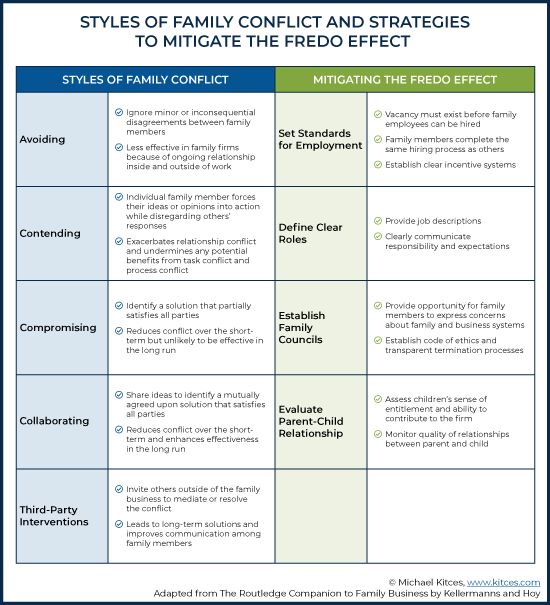
Helping Clients With A Family unit-Concern Deal With (And Prevent) The Fredo Effect
A big business with a contentious family dynamic is protecting the senior generation (and the underlying value of the business organization itself), and financial advisors can admittedly facilitate this without injuring their relationship with lower generation family unit members past putting together specialized client offerings that cater to business owners of family-owned businesses.
For instance, an advisor with a new client who is a family business possessor can offer to review the business concern' job descriptions as role of the intake procedure. For ongoing family-business-owner clients, a "job description review" item can be added to the annual client service calendar, and the chore descriptions can be reviewed for missing details also equally potential future gaps every bit the succession of the business gets underway. If the new or ongoing client has no task descriptions in place, the counselor can offer to aid create them.
Some fundamental points during a job-clarification-focused client coming together could be explored with these post-obit questions:
- Identify the roles and business structure:
- What is the organization ("org") chart of the business?
- What are the central jobs and accountabilities?
- Who reports to who and how?
- What are the ideal standards (educational activity, experience) for those jobs?
- Identify opportunities for growth and modify:
- Does everyone in a current role meet the standard requirements for their job? Do they get it, want it, and take the capacity to exercise it? If not, how do they need to grow or develop?
- What other roles or new roles might be needed in the futurity?
- Who and how does one groom electric current or new employees for positions (whether existing or newly created)?
A good job description will clarify who fits and who does not fit. With a job description in place, the next footstep involves encouraging Fredo to pace up… but not without providing some guardrails around the parents. For example, Fredo can remain in their electric current role, merely also be told that if they complete training, they may receive a new title or be added to a unlike project. However, if they exercise not complete the training, they take a chance beingness demoted or forfeiting their eligibility for a heighten until the training is complete.
In the context of Fredo-fixing, some other thing to be mindful of is that both the parent/business owner and Fredo are likely going to have a tough fourth dimension with any new rules that alter the existing dynamic. Fredo might like getting raises, and may resent the structure that now makes information technology obvious they are not fit for their job. Which in turn means a financial planner can conceptualize that while the parents (senior generation) may be on lath to create this construction (and feel good most it), they may be challenged to e'er actually implement the new plan in fearfulness of offending Fredo. In these instances, it may make sense to help the client identify an incentive program (as noted above) to encourage Fredo to strive to meet the standards required by his function.
The incentive plan tin can substantially serve to create a choice for Fredo, and give them the opportunity to evidence their worth, instead of forcing them into a new situation against their will (or continuing to enable their poor functioning or bad behavior). Fredo chooses to go better (or not), but the consequences of that choice are clear and need to be strictly enforced. In a well-designed incentive plan, the result tin can easily be a win-win.
Another thing financial advisors can do, particularly to aid back up business owner parents if they practice accept to create (and enforce) an incentive programme, is to take some responsibility for the changes happening within the business organization. Again, Fredo is non going to love beingness held to a new standard, and their parents may struggle with saying no to the quondam mode of doing business… but the advisor can easily footstep in and assert that the new strategy is in the interest of helping the concern succeed, effectively giving the parents room to 'blame' the financial advisor for the new structure (and reduce the family conflict of feeling that they are imposing it on Fredo directly)!
Having a one-on-i meeting with Fredo also gives the financial advisor the opportunity to requite straight recognition to Fredo (which is what Fredo frequently desires), while sharing their objective perspective of the situation as a fiscal planner. This can really aid to minimize the take chances that Fredo will get angry and resentful by serving equally a rubber 'buffer zone', away from the family, to hold the conversation and address the fear and relationship issues that arise. Fredo (and the family unit) may also not even realize there can be another style – working for the family doing X job is not the ONLY job out there.
The primal, though, is simply that in the same vein every bit handling a "spender" when parents just tin can't say no, advisors can stride in equally the i to say "no" to Fredo. Financial advisors can advise that all employee raises must be approved through their part, and tin involve outside business professionals in family quango meetings to aid shoot down poor ideas (or unearned raises or promotions).
A last option for advisors trying to better help clients who own family unit-run businesses is to utilise their ain small business organisation networks (as many advisors are minor business concern owners themselves) and to brand recommendations to third parties when appropriate. Alternatively, some advisors who are crafting a niche in serving small business owners may even seek to cultivate a network of various external experts to support their small business possessor clientele.
For case, advisors can go along a listing of recommended professionals that tin be presented to clients to choose, a-la-carte way, who they might desire to bring in for different situations. The 3rd parties may include:
- Professional person mediators or negotiators;
- Interim CEOs, business strategists, or business consultants;
- Family counselors; and
- Industrial Organizational psychologists.
Alternatively, for advisors who are uncomfortable disrupting family dynamics and getting directly involved in the family personally, consider running a lunch-and-learn session to address problems relating to the Fredo Outcome. As while the Fredo Effect is probably mutual among the client base of operations of advisors who often work with small family-run business concern owners, many clients might capeesh data helping them understand how to deal with it and to prevent Fredo from appearing in the first place. A lunch-and-learn session tin as well introduce clients to other tertiary parties that specialize in Fredo issues, and tin serve as a venue to disseminate data that all small business owners might discover benign (e.g., creating effective chore descriptions).
In some situations, it may also be appealing for advisors to innovate clients to 1 another, peculiarly if 1 client has had to navigate the Fredo Effect in the past. This tin be done equally part of a dejeuner-and-learn session, or in a more intimate meeting that the advisor simply arranges if both of the clients agree to information technology.
Ultimately, the Fredo Event comes about because of issues with role ambiguity and insecurity within a family business, betwixt parents who are also concern owners, and children who are also employees, where it'south often difficult to keep those roles separate and distinct.
Advisors who have worked with a family to create a Family Council, develop a family motto, and are armed with the job descriptions and an idea of potential hereafter positions for the business can assistance Fredo (and his/her parents) by discussing both their financial and personal goals.
Sometimes, this infinite may be all they need to admit that they might want to exercise something different altogether. Alternatively, though, the counselor may besides create a program together with Fredo to aid go them on runway… onto whichever path they terminate out choosing.

Source: https://www.kitces.com/blog/fredo-effect-toxic-family-business-role-ambiguity-council-motto-job-description/
0 Response to "God Set Me Free From a Bad Business Deal With Family Member"
Postar um comentário